
Turning AI potential into advantage.
One of the most significant challenges facing business leaders right now is not whether to adopt artificial intelligence, but how to do so. The organisations that get this right will lead the way; getting it wrong risks being locked into strategies that grow harder to reverse with every passing quarter. London Business School’s Data Science and AI Initiative (DSAI), launched last July, exists to help business leaders assess the potential impact of these new technologies and harness them for future growth. Donor support will be critical to expanding the DSAI’s reach and influence, advancing pioneering AI research and equipping business leaders to navigate one of the most transformative shifts in modern business.
Professor Nicos Savva and Associate Professor Keyvan Vakili lead the initiative, which spans three interconnected areas: strategy and markets, people and leadership, and governance and trust. They see a lack of trust in AI, with many organisations struggling to move beyond pilots and proofs of concept. Professor Keyvan Vakili, Associate Professor of Strategy and Entrepreneurship, warns about the hype surrounding AI and the complicated organisational questions that people are failing to ask. “Do people want to use this technology? Are they incentivised to use it? Are they trained to use it? How will it change the balance of power in companies? How will it affect their business and revenue models, their culture and learning?” He is also clear on the opportunities it presents:
The most exciting question may not be how AI fits into what we already do, but what entirely new possibilities it opens up that we simply haven’t imagined yet.
There are few business schools offering such evidence-based conversations around AI, from an online Masterclass in ‘Building an AI business’ to a series of Think Ahead panel discussions (see ‘From pilots to practice: How organisations can harness AI’, ‘Five ways to turn AI into competitive advantage‘, ‘The urgent need for AI readiness in business‘, ‘ The UK’s role in the AI era’ and ‘Human capital in the age of AI’). Engagement with AI practitioners and regulatory bodies root these conversations in today’s business challenges, but it is LBS’s cutting-edge research that will inform the conversations that help business move forward, with one third of faculty actively engaged in artificial intelligence research and applications, across all departments.
As part of its strategy to lead from the front on AI, LBS invests in adopting frontier technological innovations, with the School becoming one of the first academic partners of OpenAI in 2024. The following year an LBS AI app was introduced, offering students, faculty and staff secure access to multiple LLMs and opportunities to develop personalised chatbots. LBS also launched the One-Year MBA in 2025, designed from first principles and integrating AI into every aspect of the programme.
Keyvan warns that the challenge for companies is not actually the technology – it’s about having the organisational structure and unique road map to exploit AI’s potential. “Most companies are extremely risk-averse. Business leaders need to make sure the right technology is in the hands of the people when they need it, with appropriate governance mechanisms. The challenge is finding those unique opportunities that tap into their unique data sources, their unique context, and their unique ways of doing things. Companies need the right organisational structure to collect these ideas, test them, deploy them, and train people to adopt these tools. It has nothing to do with technology.” Those that get this right will lead the way in an AI-driven future.

LBS’s Data Science and AI Initiative unites experts to explore AI’s impact, balance it with human skills and equip leaders through research, partnerships and an AI-integrated MBA programme.
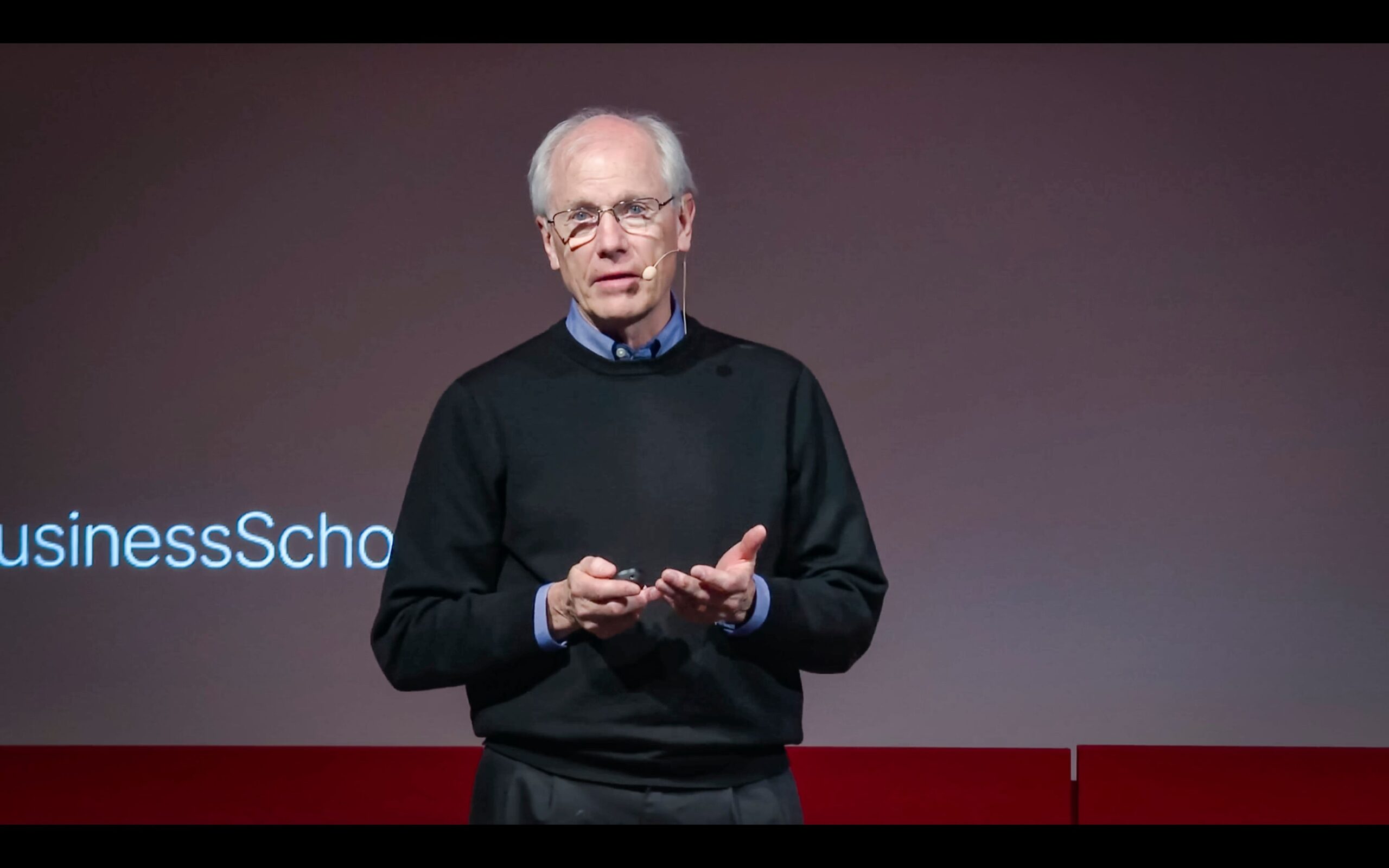
LBS professor John Mullins is preparing leaders to use AI responsibly to solve real-world challenges.

Through our work on AI, longevity and entrepreneurship, we explore the future of business and innovation – giving leaders the insights and tools to thrive in a rapidly changing world.

Or explore one of the areas below: